For years I had heard rumours that somewhere in Gippsland, in some secret valley an old miner’s hut from before WW2 still stood in pretty much pristine glory. I know of several others similar, most of which have by now seen better days or have succumbed to this century’s ‘conservation’ wildfires. I will be revisiting some of them (such as the Wildflower Mine – such an evocative name) soon too. I had a rough idea where this one was but it took me years to track down its precise location. I was told that unless I knew exactly where it was (within say twenty metres) I would just simply never find it – and that proved to be pretty much the case.
It was very steep going getting down to the bottom of the valley, the leaf litter and shale making it particularly slippery. At my age I have to be very careful of falls. I still have a very sore shoulder from my last (major) fall six months ago..


I needed a rest from time to time.
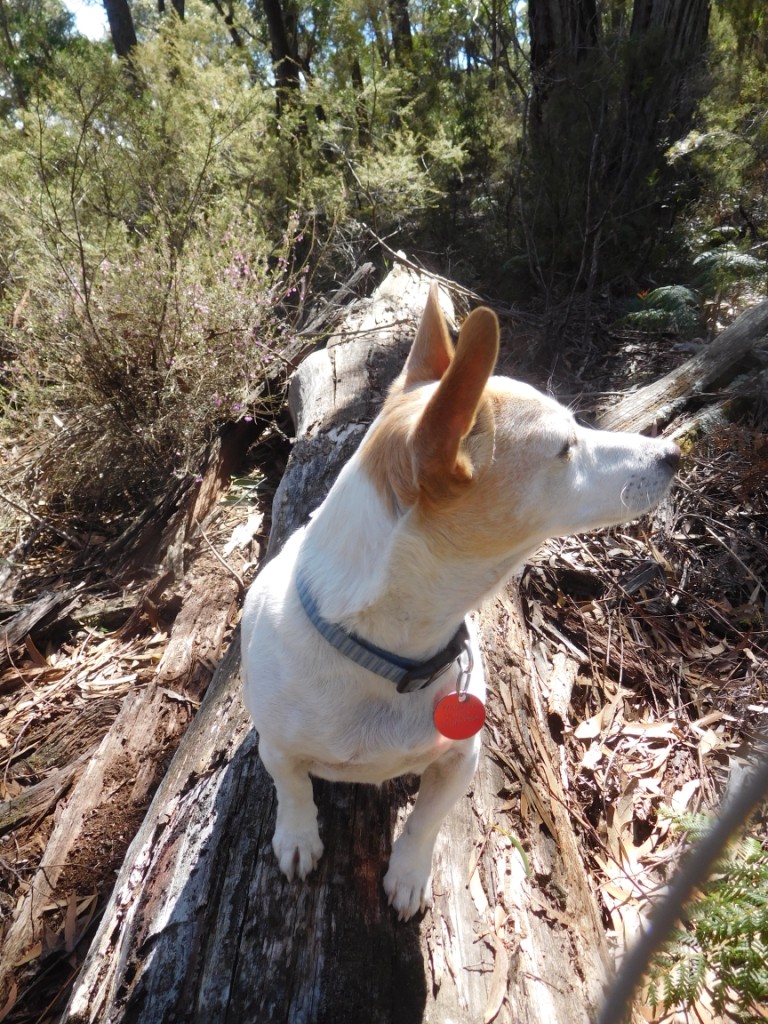
Some fairly thick bush too – with interesting denizens.

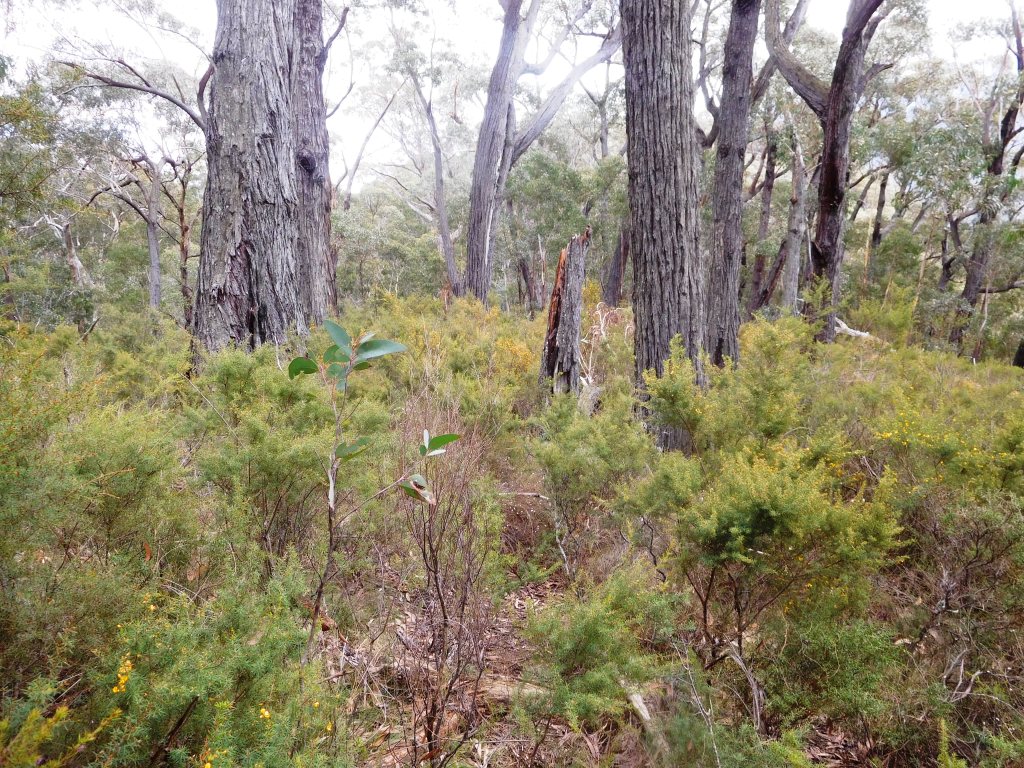

When I was in just that marked GPS location there was nothing there but fern gully after several hours of rough walking and arduous climbing down, then I spied a bit of pipe sticking up our of the ferns, so instead of despairing I cast about more widely until a stone wall emerged, then the roof of a small hut which was quite invisible until I was perhaps ten yards away. Once I was standing on the artificial ledge behind that hut the other 2-3 huts in this group all swam into view within the next ten metres. It really is quite impossible to see any of them from more than twenty metres away – unless you know where to look.

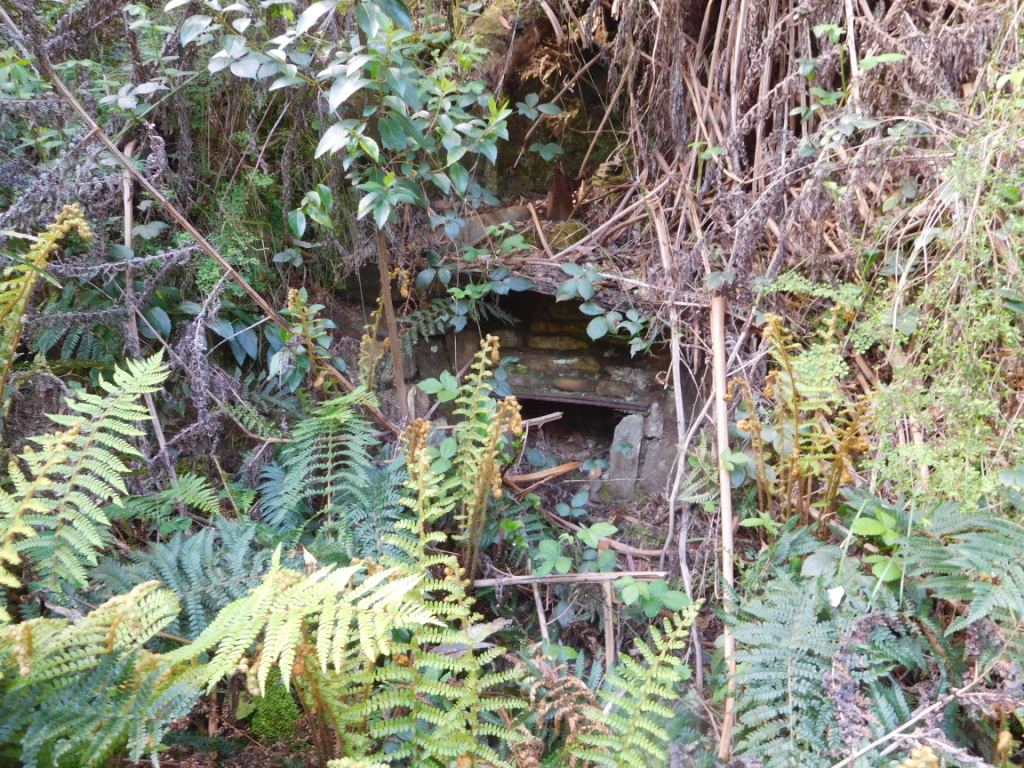
The stone circle was a DIY water tank. You may spot the brass tap at the bottom, The gutters and downpipes need to be replaced – and the tank needs a little repair. There is water available though from the gully nearby.
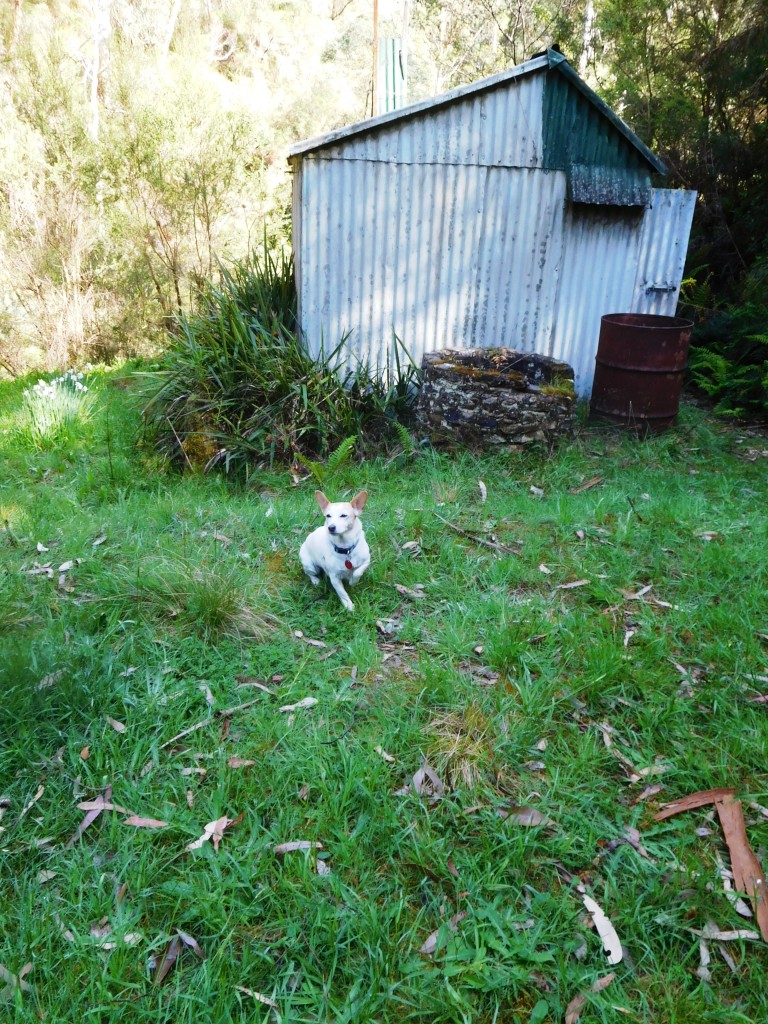
Evidently the miner (whose name I know but I too do not mean to reveal the location of this treasure) left his mine and hut circa 1956 (seventy years ago) to retire, meaning that he was born circa 1890 and likely passed on before 1980, though someone I know met him in 1970. I will try to fill in more details of his life as they come to hand (eg by a genealogy search & etc) but I would surmise that he was a veteran of WW1 (hence his desire to lose himself so deeply in the well-nigh impenetrable Gippsland bush).
On my next visit to the hut I will study the artifacts he left a little more closely to see how their mute voices can inform me of more details of his life. Clearly (for example) he was a skilled carpenter and well-rounded tradesman. The hut/s were beautifully built. It is quite outstanding how they have persisted with very little maintenance after being abandoned seventy years ago. He exercised quite wonderful planning and skill in his creations. Next time I will plan to stay for perhaps a week, taking in with me some more implements and supplies to effect needed repairs – and perhaps a companion. If only I had some other means apart from my ancient back to carry needed supplies in there. At 77 now this task too must mainly fall to the next generations – but I will do what I am able.
The two jars on the left are DIY smudge pots or candles.

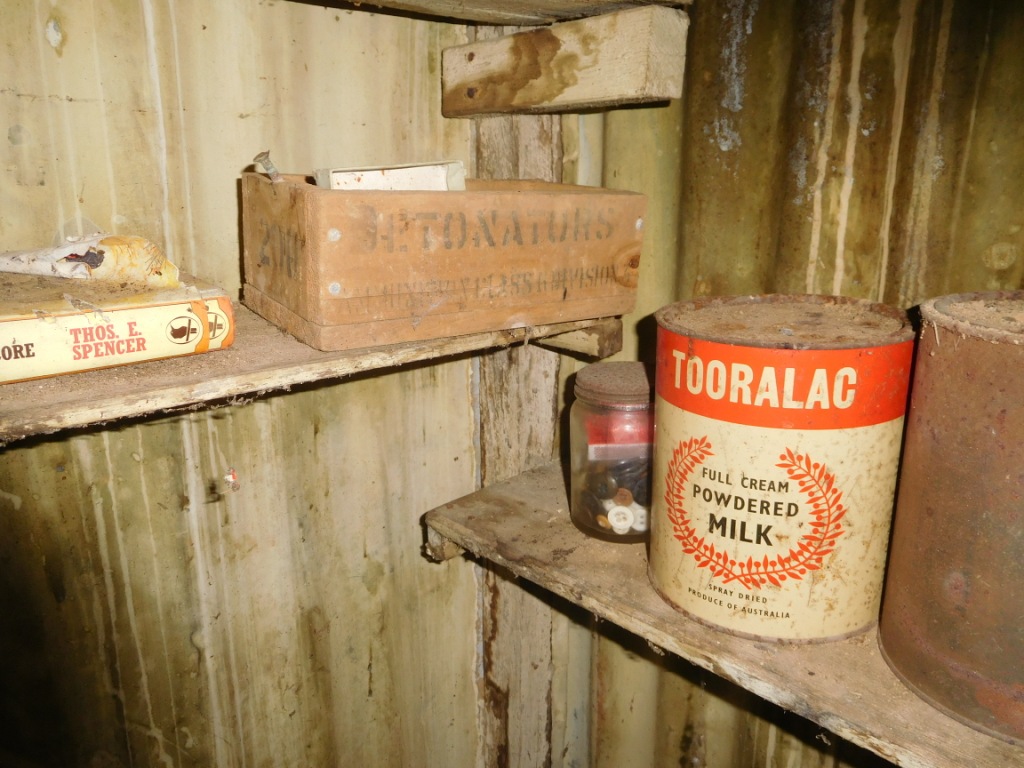
I particularly liked the detonator box and the jar of buttons – and the poetry book ‘How McDougall Topped the Score..
I understand that at one time there was a personal diary and an earlier hut log book (which have ‘disappeared’ – though they may well reappear). The current one dates from only about the last thirty years (I scanned it). It reveals that probably fewer than a dozen or so people have visited this remote habitation in all that time. No doubt one reason why it is still in such good condition. They too can clearly see its value as preserved history and mainly come in to do some work.
I left my machete, sharpener and Fiskars pruning saw to assist them with preservation work. Because of its location at the bottom a a fairly wet gully a little judicious ‘pruning’ may help it survive even the worst wildfires the ‘conservationists’ can throw at it. There is a dangerous growth of sword grass pushing up against the wall of the (main) hut which needs to be eradicated before it rots out the floor plate. In other places the flammable plants are just a little too close. Close-cropped grass (by wallabies, deer etc) in such a lush area will provide some protection from the ingress of fire which wold be moving downhill anyway.
I need to devise some way (other than my back) of getting some supplies in there. I will investigate the possibility of utilising agricultural drones which can carry up to 100kg. These would be a good way of assisting the building of your own Wilderness Hut. I imagined the old miner had a pack track which I would find by casting around in the bush – but nothing emerged. However, on the walk out I stumbled over a home-made two-strand wire ‘rope’ which I followed upwards to where it was anchored to an ironbark tree.
So the miner was able to cut a track along the less steep sections of the ridge to where his tractor or vehicle could operate a (long) winch to raise and lower loads (perhaps on a sled) up and down the very steep slope. The last 250 metres vertical takes place in only about 500 metres horizontal so that final slope must be nearly 45 degrees – pretty much the upper limit you can actually walk up. I know that 500 metres took me an hour and a half. Younger people also seem to take quite a long while to get in there too – judging from entries in the log book. Lighter electric winches and dyneema rope now exist too – so maybe this is a means by which some needed supplies could be brought in. See Also Making Tracks


I imagine he first ventured in there alone but as he ‘proved’ a little more gold he was able to attract ‘helpers’ or maybe partners as there are (now) five bunks in total – all of which need some improvements to make them serviceable. Their wire mattresses are in fairly ordinary condition (though I slept on one). The ‘flock’ mattresses which no doubt rested on them have (all but one) disappeared. Ideally one would replace them with inflatables but some means needs to be devised to prevent punctures (including slats perhaps). Of course there is a small flat where a couple of tents can be erected (I took my tent etc with me) while one is working on the huts. It is amazing too what can be devised from bush timbers. I will give it some thought.

The gold was clearly not in quartz deposits which is what you would normally expect but was in soil and rock debris from a gully as you can judge from one of his mines (pictured). That being so it is likely that he only took a portion of what is to be found. Unfortunately today much of the country which we could once prospect over is forbidden being in reserves, National parks and the like.
A friend of mine (who had applied for a dredging permit to extract it) told me (forty years ago) that there remained $3 billion worth of gold along the Jordan alone (at 1980 values) but the ‘catchment values’ forbade any such mining even though the revegetation and restoration practices necessary to do so have long since been established. I can’t imagine we can continue to throw away such opportunities in the future.


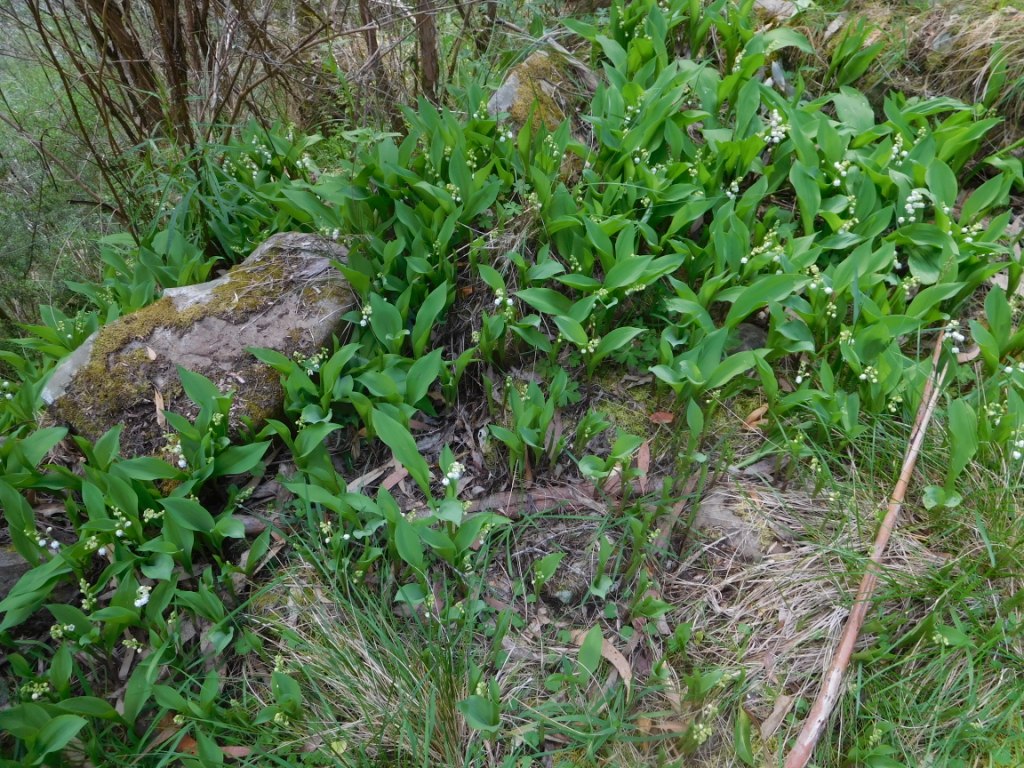
It was lovely to see that his flowering bulbs still added beauty to the site after so many years of the miner’s absence.


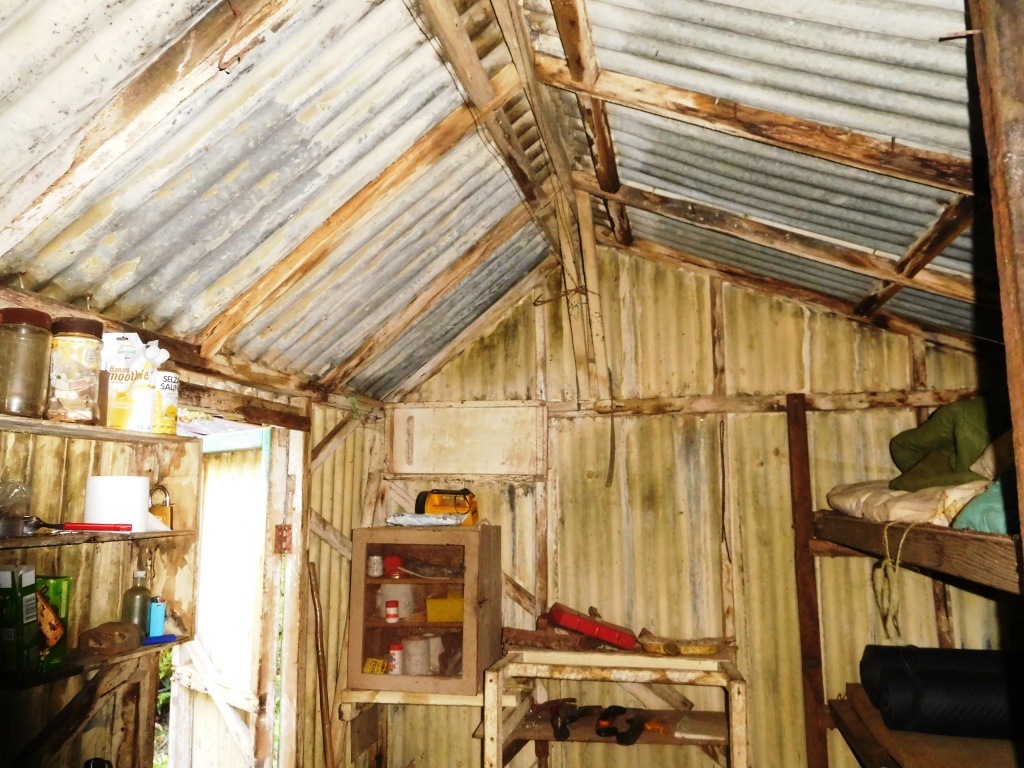
Details of the ‘main’ hut interior.

A lovely cheering fire on a cold night.

Pretending to be the miner from 70 years ago.

I love the 1940s pattern on the chair and folded quilt serving as a bottom cushion. Many a restful night was no doubt spent cogitating on it before his warming fire. The legs need some repair. I will have to take in some ‘lumber’ for this and some other small repairs. This will be difficult for me.

There are two interesting ventilation windows as well as two glass windows at present closed with sheets of iron.

Framing details. The framing was 2′ x 2″ hardwood with 2″ x 1″ cross members. A pity he had not pplaced the door a little further in. The bunks would take up less room if they were along the shorter side of the hut. BTW By my estimate the hut is 12′ x 9′. Quite enough for 3-4 people.
There are two other sheds: the upper ‘tool’ shed with two bunks plus the skillion ‘wood’ shed which was clearly used in the past for some d=sort of gold-sorting purpose. Much of the actual working of the mine (including lots of plumbing) is hidden by ferns and other vegetation – but I will work it out in the future. Note the deer head on a beautifully constructed bench, now collapsing.

The wire mattresses need some slats or something and I need to add inflatable mattresses in a canoe drum for better comfort. I wish I had made a better inventory of the available tools.

And (there is) a ‘garden’ storage shed on the same level as the main hut whose contents I though I had photographed but I am mistaken..

Could this have been a barbecue? I have much exploration yet to do of this site and its history. I will update the post.
The saw-bench and stationery engine (still functional – other parts are in the ‘tool’ shed) were certainly interesting relics.


See Also:
How To Create Water for Your Campsite
Snowy Bluff- Mt Darling Wilderness
Mt Darling – an Emerging Inferno
Upper Yarra Track Shelter House